The short version
- Most people need roughly twice as many boxes as they first estimate, and run out on the last weekend.
- Free boxes are genuinely available in Glasgow, but supermarket produce boxes are the worst of them and wine cases from an off-licence are the best.
- Buy small double-walled cartons for books and heavy items. This is the one place where free boxes reliably fail.
- Order or collect a week before you start packing, not the day you start.
- Boxes are only half the problem. Tape, paper and a marker are what people actually run out of.
How many boxes you actually need
The number depends on what you own rather than how many bedrooms you have, but there are reliable starting points. The usual mistake is estimating from furniture, when it is books, kitchens and children’s things that drive the count.
| Property | Rough box count | What pushes it higher |
|---|---|---|
| Studio or one bedroom flat | 20 to 30 | A serious book or record collection |
| Two bedroom flat | 35 to 50 | A furnished second bedroom or home office |
| Three bedroom house | 60 to 80 | Children, a loft, a garage |
| Four bedroom house | 90 plus | Loft contents, which are always forgotten |
Those ranges assume you are boxing properly rather than filling bin bags. They also assume a mix of sizes: roughly a third small, a half standard, and the rest large and specialist.
Order more than you calculate. Spare flat boxes cost little and take up no room until assembled, whereas running out at nine on a Saturday evening with a Monday date of entry is a genuine problem. Anything unused can go straight on to the next person moving, and in Glasgow there is always a next person moving.
Where free boxes genuinely come from in Glasgow
Free boxes exist in reasonable quantity if you start early and are willing to collect. The realistic sources are local selling and giving platforms, licensed shops, and other people who have just moved.
What actually works, roughly in order of usefulness:
- People who have just moved. The single best source. Local buy and sell groups on Facebook, Gumtree listings and the Glasgow subreddit all carry regular posts from people trying to clear a hallway full of flattened cartons. These are proper moving boxes, already the right sizes, and usually free or close to it.
- Off-licences and wine shops. The best free boxes in existence. Wine cases are small, double walled to carry weight, and often come with cardboard dividers that are ideal for glasses and stemware. Ask mid-week rather than at the weekend and ask when their delivery day is.
- Bookshops. Book deliveries arrive in small, strong cartons designed for exactly the weight you want to put in them.
- Reuse and giveaway networks. Freegle and similar local groups list boxes constantly, particularly through the summer.
- Small independent shops. Anywhere that takes regular stock deliveries and has to flatten and dispose of the packaging. They are often glad to see them go.
Start asking around three to four weeks before you pack. Collecting free boxes is a gradual process, not a single trip, and you need somewhere to stack them flat in the meantime. In a tenement flat, behind a sofa or under a bed is usually the answer.
Why free boxes sometimes fail
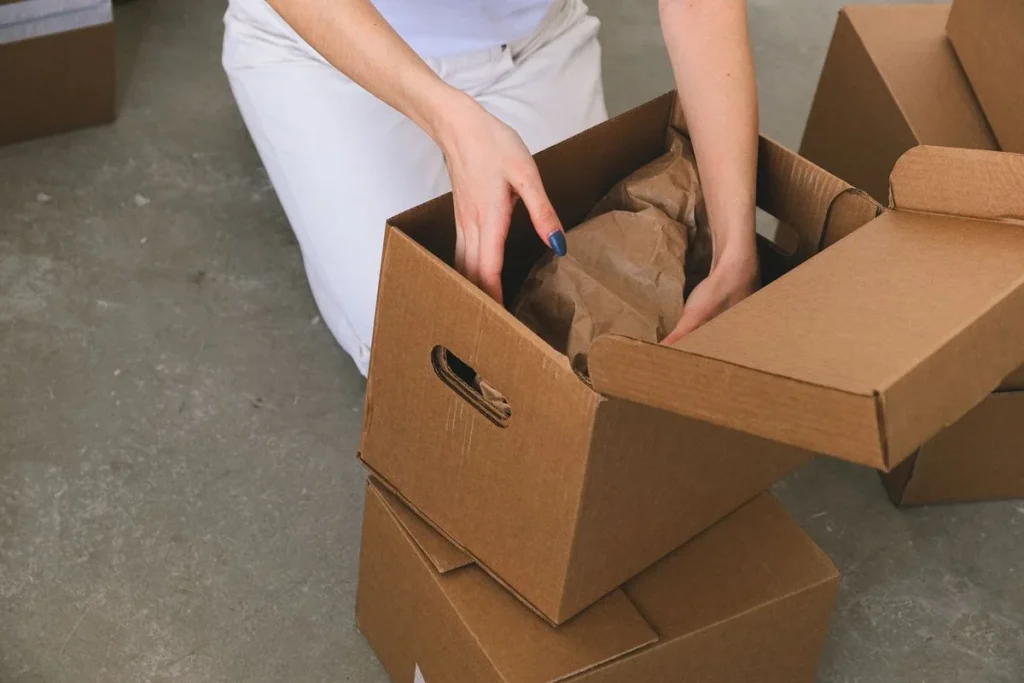
Not all free cardboard is equal, and the difference matters when a box is carried down three flights of tenement stairs. Supermarket produce trays are the ones that cause problems.
The specific issues:
- No lid, or no closable top. Produce trays are open topped and cannot be stacked safely or sealed. A box that cannot be closed cannot be stacked, and everything in a van is stacked.
- Single walled cardboard. Fine for cushions, not for books. Single wall gives way at the base under weight, usually mid-stair.
- Inconsistent sizes. A load of mixed sizes stacks badly and wastes van space. Uniform boxes are one of the quiet reasons a professional load looks tidy.
- Damp or previously damp. Cardboard that has been outside has lost most of its strength even once it feels dry.
- Food residue. Banana boxes in particular can carry insects, and they are open topped anyway.
The sensible compromise most people land on: free boxes for light, bulky, low-risk contents such as bedding, cushions, soft furnishings and clothing, and bought double-walled cartons for books, crockery, tools and anything with weight or value. That splits the cost sensibly and puts the strong boxes where the strength is needed.
Buying boxes: what to actually look for
If you are buying, the things that matter are wall thickness, size range and whether you are getting the specialist cartons that make the difference on the day.
What to prioritise:
- Double walled for anything heavy. Two layers of corrugation rather than one. It is the difference between a box that survives being stacked and one that does not.
- A small carton in the mix. Around 1.5 cubic feet, for books and dense items. If you buy only standard cartons you will overload them.
- Wardrobe cartons. A tall box with a hanging rail. Clothes go straight from rail to rail without folding, and it saves a remarkable amount of time at both ends.
- Picture and mirror cartons. Adjustable flat boxes. Framed items and mirrors should not travel wrapped in a blanket.
- Mattress covers. Cheap, and the difference between a clean mattress and one that has been down a close.
Sources in and around Glasgow include the larger DIY and home stores, storage facilities, packaging suppliers, and online sellers who deliver flat-packed bundles. Removal firms also supply materials, and if you are already booking a move it is worth asking, because delivery is usually arranged alongside the job rather than as a separate errand.
Tell us the property size and your date and we will come back with a written quote covering materials and the move.
Get a quoteWhat you need besides boxes
Boxes are the part people plan for. Tape, paper and markers are what they run out of at eleven o’clock on the final night.
| Material | Rough quantity for a three bedroom house | What it is for |
|---|---|---|
| Packing tape | Six to eight rolls | Base and top of every box, doubled on heavy ones |
| Tape gun | One | Halves the time and stops the tape twisting |
| Plain packing paper | Several kilos | Wrapping crockery and filling voids |
| Bubble wrap | One large roll | Electronics, frames, finished surfaces |
| Marker pens | Two or three | Labelling on top and one side |
| Mattress and sofa covers | One per item | Stairs, closes and back courts are dirty |
Use plain packing paper rather than newspaper on anything light coloured. Newsprint transfers, and discovering that on a set of white plates is an avoidable annoyance. Newspaper is fine for filling voids where nothing touches it directly.
Getting boxes at short notice in Glasgow
If your date has come forward or you have simply run out, there are faster options than waiting for a delivery, though they need you to be willing to drive.
In rough order of speed:
- Larger DIY and home stores around the city and the retail parks stock moving boxes on the shelf. Not the cheapest route, but you can be packing within the hour.
- Storage facilities across the city and the suburbs usually sell boxes and materials over the counter, including specialist cartons that general retailers do not stock.
- Local buy and sell groups. Post asking rather than only browsing. In Glasgow through the summer, someone within a couple of miles has just finished with a set.
- Supermarkets, as a last resort. Ask at the customer service desk rather than taking from the shop floor, and ask what time their deliveries are broken down. Accept that what you get will be mixed and mostly open topped.
One Glasgow-specific timing point. Demand for boxes spikes hard in the flat changeover around late August and September, particularly in the West End and the Southside, and again at every month end when Scottish dates of entry cluster. If you are moving at either of those moments, sort your materials a fortnight earlier than you otherwise would.
What to do with them afterwards
You will end up with a hallway full of flattened cardboard. In a tenement, that is a genuine problem rather than a minor one, because it cannot simply live in a garage.
The options:
- Pass them on. Post them on a local group. They will go within a day or two through the summer, and it saves the next person the search you have just done.
- Recycle them properly. Cardboard goes in the recycling bin, flattened. If you have more than the bin will take, Glasgow City Council operates household waste recycling centres that will take the excess, though you may need to book a slot.
- Keep a dozen. Flattened under a bed. Useful for storage, and you will move again eventually.
Do not leave them stacked in a tenement close. Closes are shared means of escape and blocking them creates a fire risk as well as an argument with your new neighbours in your first week.
When chasing free boxes is a false economy
Free boxes cost time and fuel, and there are moves where the arithmetic does not work.
Just buy them if:
- You are moving in under a fortnight. Collecting free boxes is a three to four week project. Compressed into ten days it becomes several evenings of driving.
- You are packing fragile or valuable items. A broken item costs more than the entire box order.
- You are moving from a top floor flat. Stairs are unforgiving. A base failure on a half landing is not a theoretical risk.
- You are going into storage or shipping abroad. Both need uniform, strong, sealed cartons. Mixed free boxes will not stack safely for months, and marine insurance often will not cover them.
- You do not have a car. Collecting boxes across the city without one turns a saving into a series of taxi fares.
For a straightforward local move with a few weeks’ notice, free boxes for the bulky light things and a modest order of double-walled cartons for the rest is the sensible middle ground. That is what most people who have moved more than once end up doing.
A realistic timeline for gathering boxes
Collecting boxes free works well when it is spread over several weeks and badly when it is compressed into a few days. Working backwards from your date of entry keeps it manageable and stops it becoming another job in the final fortnight.
| When | What to do |
|---|---|
| Six to eight weeks out | Start watching local buy and sell groups, and post asking rather than only browsing. Ask your local off-licence and any small shop you use regularly what day their deliveries arrive. |
| Five weeks out | Work out roughly how many boxes you need and order the double-walled cartons you intend to buy, so they arrive before you start rather than after. |
| Four weeks out | Begin packing the loft, garage and shed. This is also the point at which you discover how badly you underestimated the total. |
| Two weeks out | Top up. This is when most people realise they are short, and it is still early enough for a second free collection run. |
| Final week | Buy anything still missing rather than driving around the city for it. Tape and packing paper are the usual gaps. |
The step people skip is the purchase at five weeks. Deciding to buy cartons only once you have run out means either waiting for a delivery in the week you can least afford to wait, or paying retail prices at a DIY store on a Sunday afternoon. Ordering the strong boxes early and topping up with free ones is both cheaper and considerably calmer than doing it the other way round.
One further Glasgow point. If you are moving on a month-end Friday between June and September, assume that several other people in your building and your street are looking for boxes at the same time. Free supply dries up noticeably in those weeks, so start earlier than this table suggests rather than later.
Tell us the property size and your date and we will come back with a written quote including materials.
Get a quoteCommon questions about moving boxes in Glasgow
Are supermarket boxes any good for moving?
Mostly not. Produce trays are open topped so they cannot be sealed or stacked, and many are single walled. They are usable for light bulky items such as cushions and bedding if you have nothing else, but they are the weakest of the free options. Wine cases from an off-licence are far better and just as free.
How far ahead should I get boxes?
Have them in the flat a week before you start packing, which for a three bedroom house means about five weeks before the move. If you are collecting free boxes, start asking three to four weeks before that again, because it accumulates slowly rather than arriving at once.
What size boxes do I need most of?
Standard cartons of around 3 cubic feet make up roughly half of most orders, with small book cartons about a third and large cartons the rest. The size people under-order is the small one, then they put books in a large box and cannot lift it.
Where can I get rid of boxes after the move?
Pass them on through a local group first, since demand in Glasgow is constant through the summer. Anything left over is recycled flattened, and Glasgow City Council recycling centres will take quantities beyond what your bin holds. Do not stack them in a tenement close.
Can I get boxes delivered with my removal booking?
Usually, yes. Materials are normally dropped off ahead of the move rather than on the day, which is the point, since you need them before you start packing. Send your property size and date through the quote form and ask for materials to be included. How to use them once you have them is covered in our guide to packing for a house move.
More guides on moving in and around the city are collected in our moving guides.