Piano Removals in Glasgow, Surveyed Before They Are Booked
Uprights and grands moved across Glasgow, including the tenement stairs that make most people wonder whether it is possible at all. Every piano is assessed on its own access before a date is agreed, because that is the only honest way to quote one.
- Surveyed and planned before the job is booked
- A fixed written price, agreed in advance
- A straight answer if your stairwell will not take it
Start your free quote
No obligation. No middlemen. A real quote from our own Glasgow team.
What our Glasgow piano removals service covers
Pianos are quoted separately from ordinary furniture, and it is worth understanding why rather than assuming it is an upsell. An upright weighs roughly the same as three washing machines with the mass concentrated high up and toward the back. A grand is heavier again and cannot be moved on its own legs at all. Neither behaves like a wardrobe, and neither forgives a bad decision on a stair.
So a piano move is planned before it is priced. We need to know what the instrument is, where it sits now, where it is going, and precisely what stands between those two points. That is not paperwork for the sake of it. It is what determines whether the job takes two people or more, whether it goes through a door or has to go another way, and occasionally whether it can be done at all.
If you are moving a piano along with a whole household, that is a house move with a piano in it and belongs on our house removals page. If it is the piano plus a few other pieces, see furniture removals. This page is for the instrument itself, which is where the specialist part sits.
Why a piano is not ordinary furniture
None of this is about being precious. It is about what the object actually is, and every one of these facts changes how the job has to be approached.
The weight, and where it sits
An upright runs from roughly 150kg to 400kg depending on size, a grand from about 300kg to well over 500kg. More importantly the mass is not evenly spread: in an upright most of it is high and toward the back, around the cast iron frame, which is why an upright tipped slightly too far does not simply lean, it goes.
The castors are decorative
Piano castors are designed to let an instrument be nudged a few inches on a level floor, not to carry it anywhere. Rolling a piano across a room on its own castors is how floors get gouged, castors shear off and instruments end up on their side.
A cast iron frame under tension
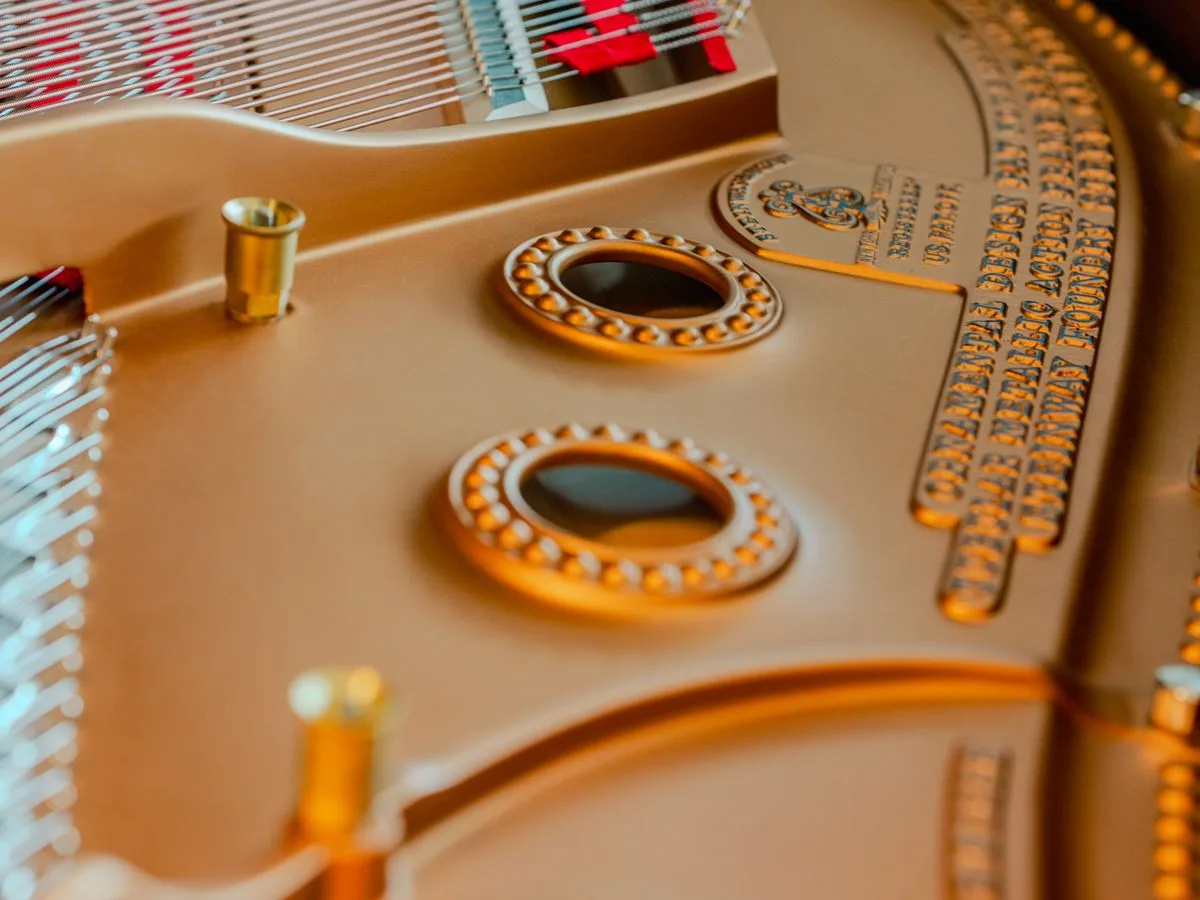
Inside is a cast iron plate holding around 220 strings at a combined tension measured in tonnes. It is robust, but it is also the reason a piano is as heavy as it is, and the reason the weight distribution is so unforgiving.
The action is precision machinery
Several thousand moving parts in a mechanism built to fine tolerances. It survives being moved properly and does not enjoy being jolted, dropped the last few inches onto a floor, or left leaning at an angle for a long period.
The finish marks easily
Polyester lacquer, the mirror black on most modern pianos, is hard but shows every scuff and is difficult to repair invisibly. Older French polish and veneer are softer still. This is why the instrument is wrapped before it moves rather than at the van.
It will not fit where you think
A piano that came into a room years ago may have arrived before a door was rehung, a wall built or a stair carpet fitted. Assuming it can go out the way it came in is the single most common cause of a piano move failing on the day.
Pianos we move
Tell us the make and model if you know it, and roughly how old it is. Between that and a photograph we can usually identify the type and weight range before anyone visits.
Upright pianos
Spinet, console, studio and full upright. The most common piano move by a wide margin, and the one most often found on an upper floor of a tenement.
Grand pianos
Baby, parlour and larger grands. These come apart before they travel, which is the main practical difference from an upright, and they need considerably more room to manoeuvre.
Digital and stage pianos
Far lighter and much simpler, though weighted key stage pianos are heavier and more awkward than people expect. Usually a straightforward job.
Organs and harmoniums
Reed organs, harmoniums and church style instruments. Often lighter than an upright but bulkier, and frequently older and more fragile.
Stools, benches and accessories
Piano stools, adjustable benches, music cabinets and sheet music storage. Moved alongside the instrument as part of the same job.
Player and self-playing pianos
Disklavier, PianoDisc and similar systems. Mechanically an ordinary instrument with electronics attached, so the control box and cabling are disconnected and travel separately.
How an upright piano is moved
This is the standard method for an upright, and it is worth knowing what a proper job looks like whoever you end up booking.
Secured and protected
The keyboard lid is closed and secured so it cannot swing open mid lift, the top lid is fastened, and any loose fittings are dealt with. The instrument is then blanket wrapped, corners included, before it leaves its position.
Onto a trolley, not its castors
An upright is transferred onto a piano trolley or skate so the weight is carried on equipment designed for it rather than on decorative castors. It is strapped to that equipment before it goes anywhere.
Controlled movement to the door
Moved slowly, with the mass kept low and the instrument kept upright. Doorways are measured before rather than tested during, and door leaves come off their hinges where that is what makes the difference.
Stairs taken one step at a time
On stairs the instrument is controlled from below rather than pushed from above, and it descends step by step under restraint. This is the part that determines how many people the job needs, and it is decided at survey rather than on the day.
Loaded and secured
Into the vehicle and strapped so nothing can shift in transit. An upright travels standing, braced against the side of the load rather than free in the middle of it.
Delivered and positioned
The same sequence in reverse at the far end, and the instrument placed where you actually want it in the room rather than left inside the front door.
How a grand piano is moved
A grand is dismantled before it travels. That surprises people who assume it goes out as it stands, but it is standard practice and it is what makes the instrument manageable through ordinary doorways.
Lyre and pedals removed
The lyre, the assembly carrying the pedals, comes off first. It is the most exposed and most easily damaged part of a grand and it never travels attached.
Legs removed in sequence
A grand is lowered onto its side in a controlled sequence, with each leg removed as the weight comes off it. This is the step that genuinely requires knowing what you are doing, because the instrument is heaviest and least stable partway through it.
Onto a padded skid board
The body is transferred onto a padded skid, which supports the straight side and takes the load along its length. The instrument then travels on its side on that board rather than upright on its own base.
Wrapped and strapped
Blanket wrapped over the whole body, then strapped to the board. Legs, lyre and fittings are wrapped separately and travel with the instrument so nothing is hunted for at the far end.
Loaded and secured
The skid is loaded and strapped so the instrument cannot move, with the legs, lyre and fittings secured alongside it rather than travelling loose in the vehicle.
Reassembled and levelled
Rebuilt in reverse at the destination, back onto its legs, lyre refitted and the pedals checked. The instrument is levelled in its final position rather than left sitting on an uneven floor.
A grand on its skid is still long, and the length rather than the weight is usually what decides whether it will make a turn on a stair or a landing.
Stairs, tenements and Glasgow access
Glasgow is a city of upper floor flats reached by shared stone stairs, and a large share of the pianos in it are sitting two or three floors up. That is the single biggest factor in any piano move here, and it is why we will not quote one from a postcode alone.
The limiting measurement on a tenement stair is almost never the width of the flight. It is the diagonal across the half landing where the stair turns back on itself, and the clearance between the inside newel post and the outside wall. A piano that goes up a straight flight comfortably can be completely stopped by a turn, because there is nowhere to swing the length of the instrument.
Banisters matter too. Older closes often have a handrail that reduces the usable width at exactly the height a piano needs it, and whether that rail can be temporarily removed is sometimes the difference between a job being possible and not. Victorian internal doorways are frequently narrower than modern ones, and the door leaf itself often has to come off its hinges.
Then there is the street. Much of the West End, the city centre and the inner Southside is permit controlled, and the distance from the van to the close door is real work when the load is this heavy. Where a parking suspension is worth arranging we will say so, and city centre jobs need planning around the Low Emission Zone and enforced loading windows. On timing, our guide to when to book a removal company in Scotland sets out the detail.

What we need to know in advance
- Which floor, at both addresses
- Whether the stair turns, and how tight
- Banister or handrail clearance
- Narrowest doorway on the route
- Lift access and internal lift dimensions
- Parking, and how far the van will sit
When a stairwell simply will not take it
Occasionally the answer is that the instrument cannot go up or down the stair at all. This is most common with grands going into or out of upper floor flats, where the length of the body on its skid cannot make the turn at the half landing no matter how it is approached.
Where that happens, the established solution in the trade is to take the instrument through a window or over a balcony using external lifting equipment. It is a specialist operation in its own right: it needs the window or opening surveyed, the load path assessed, the street or back court closed off where required, and the lift arranged in advance with the right equipment and operators. It is never something to attempt on the day as a fallback when the stair has defeated everyone.
The important thing from your side is simply to know it exists as an option, and to expect any company quoting your job to raise it themselves if the survey suggests the stair is marginal. If nobody has mentioned access at all and your piano is on the second floor, that is worth questioning.
Piano weights and dimensions guide
Typical ranges by piano type, so you can work out roughly what you are dealing with before anyone visits. Treat these as approximate: instruments vary considerably by maker and age, and an older overstrung upright can be far heavier than its height suggests. If a nameplate or model number is visible, that will give a more exact answer than any table.

Spinet upright
Roughly 135 to 180kg. The smallest and lightest upright type, and the one most likely to go up a tenement stair without difficulty.
Console upright
Roughly 160 to 230kg. Common in domestic living rooms and generally manageable on stairs with the right number of people.
Studio upright
Roughly 180 to 270kg. Often found in schools and teaching rooms. Noticeably heavier than a console and a different proposition on a turn.
Full upright
Roughly 230 to 400kg. Older overstrung and professional uprights sit at the top of this range and are the heaviest instruments regularly found in flats.
Baby grand
Roughly 230 to 300kg. The shortest grands, and the length on the skid is usually the deciding factor rather than the weight.
Parlour or medium grand
Roughly 300 to 400kg. Common in larger homes. At this length, stair turns become genuinely restrictive.
Semi-concert grand
Roughly 400 to 500kg. Rarely found above ground floor in domestic property, and for good reason.
Concert grand
Roughly 450 to 550kg and upward. Almost always a ground floor or venue instrument with dedicated access.
How to measure your access against it
Measure the instrument three ways
Height, width and depth for an upright. Length, width at the widest point and height for a grand. Write them down before you contact anybody, because it is the first thing you will be asked.
Measure the half landing diagonal
Stand at the turn in the stair and measure from the inside corner to the outside wall on the diagonal. That number, not the width of the flight, is what an upright has to pass through.
Measure the narrowest doorway
Measure the frame itself with the door standing open, not the opening in the wall. Then check whether the leaf can come off its hinges, which typically buys back around 40mm.
Check banister height and clearance
On a shared close, measure from the handrail to the opposite wall as well as at floor level. The rail is often the pinch point rather than the stair.
Check the lift properly
Internal depth, door width and internal height. Some service lifts have a removable ceiling hatch that lets a tall item stand at an angle, which occasionally solves an upright entirely.
Photograph the route
A short video walking from the street door to the room, taken on a phone, tells an experienced mover more than any set of measurements. Send it with your enquiry.
After the move: tuning and settling
Expect your piano to be out of tune after it is moved. That is normal and it is not a sign anything went wrong. Pitch shifts because the soundboard and frame respond to a change in temperature and humidity, far more than because of the journey itself, which is why a piano moved between two rooms in the same house can also go off.
The usual advice is to leave it two to three weeks before booking a tuner. Tuning it the day after it arrives generally means paying for the same job twice, because the instrument has not finished acclimatising to the new room. If it has come from a very different environment, a cold church hall into a heated flat for instance, longer is better.
Where you put it matters more than most people realise. Keep a piano off an exterior wall where you can, away from radiators and other heat sources, out of direct sunlight, and clear of the draught from a door opening onto the street. A stable room is worth more to an instrument than a perfect position in an unstable one.
We are movers rather than technicians, so we do not tune or regulate instruments. If you need a tuner, a local piano dealer or teacher will point you at one, and it is worth booking a few weeks ahead.
Piano storage
If a piano is going into storage between properties, the environment is the thing that matters. Instruments dislike swings in temperature and humidity far more than they dislike sitting still, and a cold or damp store over a winter will do more harm than the move ever could. A stable, dry environment is not optional for a piano in the way it arguably is for a sofa.
Our removals and storage page covers how storage works alongside a move generally.
What to tell us when you ask
A piano enquiry needs more detail than an ordinary removals one, and that detail is what lets us answer properly rather than hedge. A photograph of the instrument and a short video of the route are worth more than any written description.
Type, make and model
Upright or grand, the name on the fall board, and a model number if there is one. That alone usually gets us to a weight range and a footprint.
Roughly how old it is
Age is a reasonable proxy for construction. Older overstrung uprights are heavier than modern instruments of the same height, and older finishes are more delicate.
Which floor, at both ends
The single most important thing on this page. Ground to ground is a very different job from second floor to third, and it changes the method, the crew and the timing.
Stair turns and door widths
Whether the stair turns, roughly how tight it is, and the narrowest doorway on the route. Approximate numbers are fine. We would far rather have rough figures than none.
Lift access
Whether there is a lift, and if so its internal dimensions. In a managed building, whether it can be booked, since most require notice.
Dates, and whether storage is involved
Your preferred date and how firm it is, and whether the instrument is going straight to a new address or into storage in between.
If you are unsure about the measurements, send what you have and we will tell you what else is needed. On anything above the ground floor we would normally want to see the access ourselves before confirming a date.
Moving a piano in Glasgow?
Send us the instrument type, both addresses and the floor at each end. A photo of the piano and a short video of the stairs will get you a much faster answer.
Where we move pianos across Glasgow
Across the city and the towns around it. The West End and the inner Southside account for most of the upper floor tenement work, and the suburbs for most of the ground floor and detached house jobs where access is far simpler.
- West End & Partick
- Hyndland & Broomhill
- Finnieston & Yorkhill
- Southside & Shawlands
- Pollokshields & Strathbungo
- Giffnock & Newton Mearns
- City Centre & Merchant City
- Dennistoun & East End
- Bearsden & Milngavie
- Cambuslang & Rutherglen
- Paisley & Renfrew
- East Kilbride, Hamilton & Clydebank
Pianos also travel with a move out of the city. If you are leaving Glasgow, the instrument goes with the rest of the household rather than being handed to a separate company at the boundary.
What customers say about piano moves
“They came and looked at the stair before agreeing a date, which nobody else had offered to do. The upright came down three flights without touching a wall.”
Elaine M.
Upright, West End tenement
“Our baby grand was taken apart, moved and put back together in the new house. Legs and lyre all came back on properly and it was level before they left.”
Douglas F.
Baby grand, Newton Mearns
“Honest advice more than anything. They told us the turn at the top would not take it and talked through the alternatives rather than just turning up and failing.”
Rebecca A.
Upright, Dennistoun
Piano removals questions, answered
Often yes, and it is routine work in this city. Whether a specific instrument will make a specific stair depends on the diagonal across the half landing turn rather than the width of the flight. That is why we look at the access before agreeing a date rather than after, and why we will tell you plainly if the answer is no.
Yes. A grand is dismantled before it travels: the lyre and pedal assembly come off, the legs are removed in sequence and the body goes onto a padded skid board, then it is rebuilt and levelled at the other end. Send the length and the make and we will tell you what the job involves.
Almost certainly, and that is normal rather than a sign of damage. Leave it two to three weeks to acclimatise to the new room before booking a tuner, otherwise you are likely to pay for the same job twice. We move instruments, we do not tune them.
On a grand, yes, always. That is how a grand is moved. On an upright, no, the instrument stays intact and travels upright on proper moving equipment rather than on its own castors.
A piano can be stored, but the environment matters much more than it does for ordinary furniture, because instruments react badly to swings in temperature and humidity. Tell us if storage is part of the plan and we will talk through what is suitable.
Two to three weeks is sensible, partly for scheduling and partly because upper floor jobs usually want the access seen first. If your date is already fixed and close, call anyway and we will tell you honestly what is possible.
Yes, and they are far simpler. Weighted key stage pianos are heavier and more awkward than people expect, but they are nothing like an acoustic instrument to handle.
Instrument type and make, roughly its age, the floor at both addresses, whether the stairs turn, the narrowest doorway, and whether there is a lift. Photographs of the piano and a short video of the route from the street door will usually answer most of it.
Related services
If the piano is part of a bigger job, one of these is the right starting point and the instrument is quoted within it.

Single items and part loads, where the care goes into the piece rather than the whole property.

Whole home moves across Glasgow, surveyed and run as one planned job with a crew sized to finish inside a day.

Move and store on one booking, for the gap between one property and the next.

A van and one or two crew for smaller jobs, single rooms and everything short of a whole home.

Full, part or fragile only packing, with materials supplied and unpacking at the far end.

Desk based office moves with IT, phased departments and the work scheduled around your trading hours.
Get a free piano removals quote
Tell us what the instrument is, both addresses and the floor at each end. Photographs of the piano and a short video of the stairs will get you a far quicker and more accurate answer. If you would rather talk it through first, call 0141 000 0000 or use our contact page.
Start your free quote
No obligation. No middlemen. A real quote from our own Glasgow team.